Most classes I teach are technical, on subjects like how to draw letters and form flourishes, how to control a pointed dip pen, or how to use Procreate for iPad lettering. But in my own practice, I pick up my pen because calligraphy is a genuinely mindful practice that connects my mind to my body.
My Skillshare class, Calligraphy for Mindfulness, is about that. The first half is my love letter to calligraphy, where I share my reflections on the unique benefits of calligraphy as a practice, and the broader benefits of writing by hand. Then, together, we do a calligraphy exercise that emphasizes the process of handwriting over the finished product.
Part One:
Calligraphy as a mind-body practice
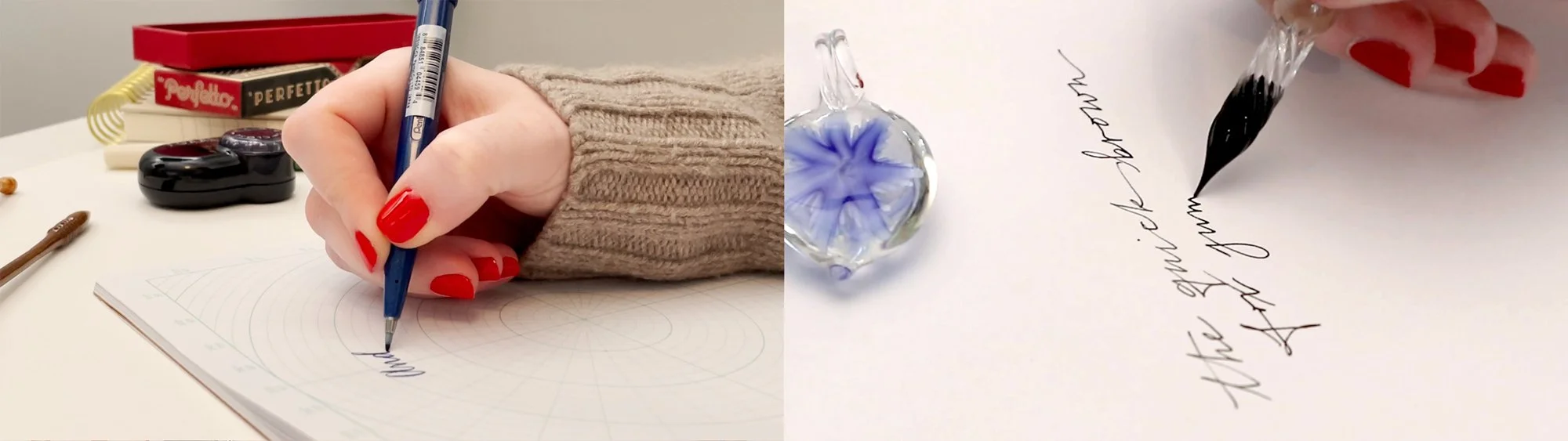
Writing by hand creates a unique connection between mind and body. When you put pen to paper, your whole body engages—the looseness of your shoulder, the arc of your wrist, the pressure of your fingers on each stroke. Handwriting creates a unique connection between our mind and our body, which echoes that of other natural human actions—but like breathing, we’re mostly unaware of the process until we slow down to notice it. Think about when you speak or walk, and how you unconsciously adjust your pace, posture, breath, and even the intensity of your movement in accordance with your emotions and environment.
Likewise, when we put pen to paper, our writing speed and the force behind it ebb and flow with our mindset and surroundings. I’m sure that every person is familiar with this sensation, whether consciously or not, but doing calligraphy, as opposed to everyday handwriting, amplifies these sensations because it has to be done so much more slowly. Unlike everyday handwriting, fine penmanship really can’t be written fast and furiously. And in that enforced slowness, our barrage of competing thoughts quiets. We start to absorb the words we're writing, rather than just transcribing them.
Writing calligraphy gives me the satisfaction of writing and reading combined. Slowly shaping each and every letter and word forces me to absorb them—to really reflect on them. By stripping away the barrage of thoughts and the rush to get them down on paper, calligraphy allows us to enjoy the way that words, thoughts, and physical movement harmonize.
Part Two:
Creativity meets uniformity
Calligraphy is a unique art form in that it’s the meeting of creativity with uniformity. Because we can’t make up letters from scratch, calligraphy must walk a fine line between creative interpretation and adherence to predetermined parameters—or to the shapes of letters themselves. In other words, as calligraphers, we take creative license with standardized forms.
In that sense, our work exists in the space between individuality and conformity. While that might sound reductive, while it might make calligraphy sound limiting in some way, calligraphers have embraced these parameters for centuries, pushed their boundaries, and found it liberating to do so. (Indeed, the evolution of the world’s alphabets has mostly happened at the hands of calligraphers, not with a printing press or design software.) Because letters are the visual embodiment of language, we’re not only creatively interpreting letter shapes in a vacuum, but we’re representing language as well.
Part Three:
Process over product
In many calligraphy traditions around the world, the literal act of writing calligraphy is as meaningful—or more—than the finished calligraphy composition itself. The process—from stroke direction and stroke order to hand movement—is considered as much an art form as the finished product, which is seen as a reflection of that human endeavor.
For the most part, Western calligraphy tradition has placed more emphasis on the finished letters than the human act of writing them. I would go so far as to say that sometimes (though certainly not always) the humanity inherent in calligraphy gets overshadowed by discussion of its technical considerations. And the proliferation of calligraphic typefaces, while meant to convey an organic, personal feeling, has only further separated the hand from the handwriting.
When I really learned to enjoy the process of calligraphy more than the finished product, my creativity and enjoyment in the art form increased exponentially. And as a bonus consequence, I think my work improved a lot, too—but that’s kind of the opposite of the point here, isn’t it?
I noticed this most clearly when I started feeling ground down by social media. Nothing drains my creative energy faster than making something with an audience in mind before I’ve even begun. Will people like this? Is this lettering style trending? How will this fare in the algorithm? And perhaps the most toxic thought of all: If my work doesn’t get traction, does that mean it wasn’t worth making?
That kind of pressure to “produce content” turns a creative practice into an assembly line, where art is reduced to blips on a newsfeed. Keeping up this level of productivity is hard for anyone, but when this “content” is inextricably linked to your creative energy, it becomes nearly impossible to be hyperproductive for long periods of time while maintaining your passion for the art form.
The mental shift that has benefitted me the most was separating my art-making from my art-sharing. When I do calligraphy purely for myself—no client, no post, no end goal—my enjoyment of it comes back. And almost always, the work I'm most proud of comes from exactly that space—which I judge as the work I’m most proud of.
If you’re trying to do the same, that means practicing calligraphy for yourself and yourself alone. And viewing it truly as just that: practice. It’s practice in that we’re always learning, but it’s also a practice—in focus, introspection, and acceptance.

Part Four:
The tactile connection
Writing by hand is deliciously tactile. As humans, we are drawn to activities that keep our hands busy and working. When we say we’ve created something “with our own two hands,” we mean that it’s an achievement, and it’s wholly our own creation. And creating something—anything—with our own two hands gives us agency and autonomy—and a deep sense of satisfaction.
Writing by hand, whether flourished calligraphy or everyday handwriting, exemplifies this tactile satisfaction. Writing utilizes fine motor skills in a uniquely enjoyable way. (In the English language, the word “hand” can even mean a handwriting style—an acknowledgement that a page of writing is inextricably linked to the actual hand of its writer.)
As important and revolutionary as computers are, the specific tactile pleasure of holding a pen and making the small movements of forming letters can never be replicated with a keyboard.
Part Five:
A Guided Calligraphy Exercise
I’ve developed a practice for purely personal calligraphy that’s extremely meditative for me. It reminds me why I started doing calligraphy in the first place. It refocuses me. It keeps my love of the art form fresh. And most importantly, since I do it without any goal or expectations, my mind can wander to other areas of my life while I work. I find myself reflecting on problems or de-stressing after a long day.
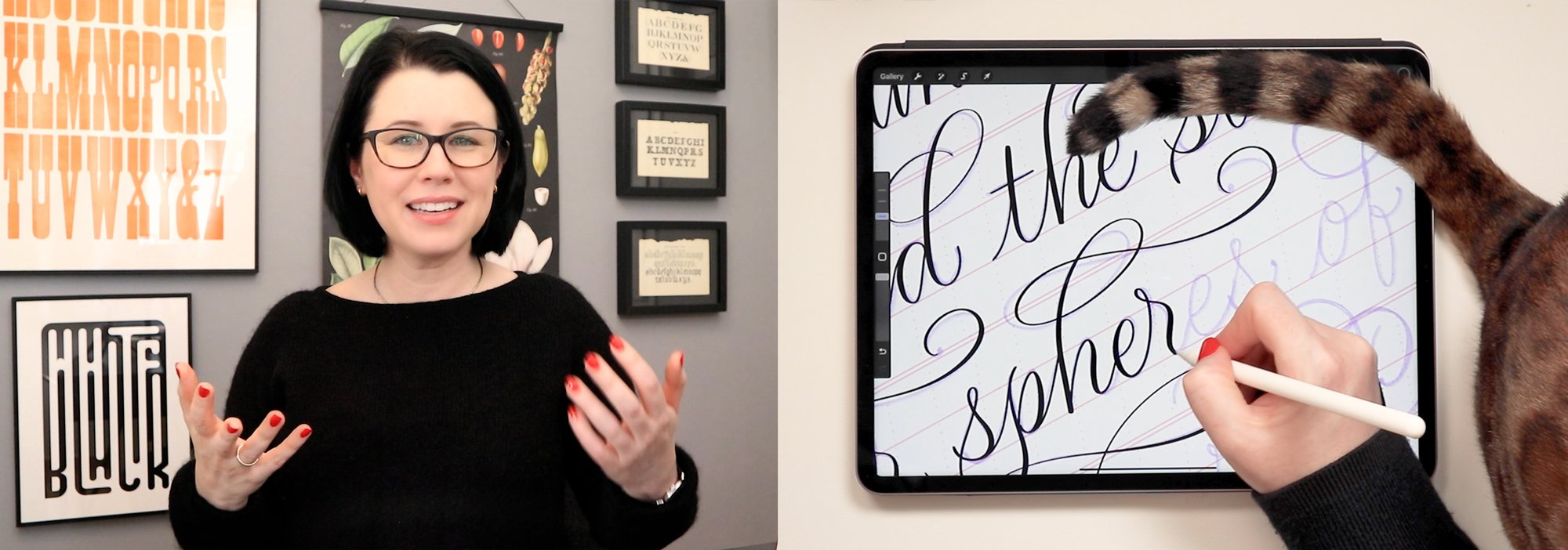
In the second half of the class, I'll guide you through a meditative calligraphy exercise. You’ll need to pick a short text or poem, then you can follow along with using any tools you like—pen on paper or stylus on tablet screen.
Sometimes, figuring out what to write is agonizing. This is true across the board with creatives, from painters picking their subject to knitters choosing their next pattern. I keep my favorite, most well-worn books around me, which I’ve highlighted, dog eared, and annotated over the years. For me, these provide endless inspiration when I need some good text to calligraph for myself. All I have to do is flick through and land on an underlined passage that resonated with me the first time I read it, and usually it resonates with me still.
This class is for all lettering artists.
Whether you prefer dip pen and ink, pen in a notebook, or digital calligraphy on a tablet, you can follow along with this class exercise.
My hope is that this class will benefit you in more ways than one. You’ll see the many ways that writing slowly by hand forms connections, both internal and external: connection to ourselves, to each other, to the past, to people we don’t even know, and quite literally, to itself, through letterform connections. And hopefully, you will also feel inspired to explore your own calligraphy practice in new ways, from different angles.
Enroll in Calligraphy for Mindfulness on Skillshare →
What my students are saying:
★★★★★
Wow, what an eye-opening class, laid out so poetically. This is by far Molly’s best work.
— Daksha
★★★★★
This class is beautifully composed and beautifully delivered. I am very much a beginner with calligraphy, and Molly’s insights have not only been encouraging but they have also given me new perspectives on handwork in which I feel proficient. I would recommend this class to anyone who likes to work with their hands, to anyone who struggles to maintain a creative practice, and, of course, to anyone interested in handwriting and calligraphy. A gem.
— Elizabeth
★★★★★
This is the type of inspiration I am searching for.
— Catherine
★★★★★
I'm starting to practice again and this class guides me step by step what I need to know.
— Novita
★★★★★
This class is so relaxing and informative!
— Belle
For a taste of what the class offers, watch the teaser:
…and get one month of Skillshare Premium free.
If you’re not yet a Skillshare member, the button above will unlock a 4-week trial of Skillshare Premium—no commitments, no strings attached.
As a Top Teacher on the Skillshare platform, I offer lots of classes about calligraphy, typography, Procreate, Adobe Photoshop, and creative freelancing.
If you found this post useful, consider sharing it. That’s the best, free way to support artists and authors you appreciate. You could also buy me a coffee, if you’d like.